 and 2 on
the real line as if we have equality, and we alternate + and - from the
right to the left, so our answer to this question is
and 2 on
the real line as if we have equality, and we alternate + and - from the
right to the left, so our answer to this question is 
Review on solving inequalities from College Algebra
Qudadratic Inequalities
Type I. Standard Form (coefficients of x are positive and the degree of each factor is 1.)
Example: Solve (x-2)(3x+1)<0. We get two points and 2 on
the real line as if we have equality, and we alternate + and - from the
right to the left, so our answer to this question is
Type II. Non-Standard Form, but can be made standard by multiplying ''negative(s)''.
Example: Solve (-x-2)(3x+1)<0, this is not in standard form, but we can
multiply (-x-2) by -1, which yields, (x+2)(3x+1)>0. So the solution
will be 
Type III. Can't be made standard, needs to use a table
Example: Solve (3x+1)2(x-2)(x-3)<0. First we get  and 3.
Next we complete the following table:
and 3.
Next we complete the following table: 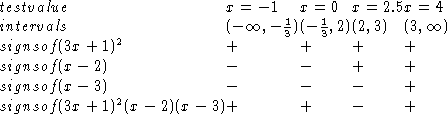 Therefore the answer is (2,3).
Example: Solve  According the table above, the
answer will be
According the table above, the
answer will be  or
or 
Fractional Inequalities
Example: Solve 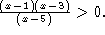 This is equivalent to solve (x-1)(x-3)(x-5)>0. We know that we can apply the ''standard form''
technique to do this one.
This is equivalent to solve (x-1)(x-3)(x-5)>0. We know that we can apply the ''standard form''
technique to do this one.
Example: Solve 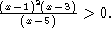 This is equivalent to solve (x-1)2(x-3)(x-5)>0 and we can make a table to solve this problem.